

Can I Fit 4/4 Size Double Bass Strings On A 3/4 Size Double Bass
In the latest instalment of his monthly blog, Franz Klanner, director of applied science and technology at Thomastik-Infeld, discusses double bass strings
'The double bass is the almost hideous, ungainly and inelegant instrument ever invented,' rages the protagonist in Patrick Süskind's one-act play 'The Double Bass'. Quite conspicuously, we retrieve otherwise and are dedicating this weblog entry to the double bass and all its special features. Because what would an orchestra be without the deep tapestry of sound of the basses?
The double bass is not only the largest and deepest instrument in the violin family, it also has the richest diversity of shapes and sizes in comparison with the violin, viola and cello. The mensur, i.due east. the vibrating string length (see the "Vibrating string length" blog entry for more than information), of the double bass is far less standardized than that of the violin or the cello:
- In the case of violins, the vibrating cord lengths are between 32.v cm and 32.8 cm on average.
- Cellos essentially have vibrating strings lengths of effectually 70 cm. Thomastik-Infeld as well states that the vibrating string lengths for cello strings is 70 cm.
- For violas, there are no clear standards. The human relationship betwixt trunk length and vibrating cord lengths varies. It is possible to have a small-scale body with a longer vibrating cord length or a large body with a shorter vibrating string length. Still, on average, the mensurs for violas are between 37 cm and 38 cm.
- Like to violas, the sizes and proportions are very dissimilar for double basses. The current standard size is the 3/4 size, which corresponds approximately to a vibrating string length of 103-106 cm. For a iv/4 double bass, a vibrating string length of 106-110 cm is usual, merely there are also instruments outside these standards.
The double base is a deep instrument with notes that are tuned in fourths: Eane-Ai-D-Yard. In the orchestra, it oftentimes plays the cello part transposed an octave lower. Notwithstanding, there are no notes below the E1 notation, which is why double basses with low notes extending down to B2 or Ci are often needed in the orchestra. In principle, there are two ways to produce extra-low notes on a double bass:
one) The C-Extension
Many bassists appreciate the greater ease of playing a 4-stringed bass but would nonetheless like the range of a 5-stringed bass for their repertoire. The possibility of an extension is very welcome here, as the extension is much cheaper than a 2nd instrument with five strings. The so-called C-Extension uses a fingerboard extension on the East-string to go far possible to play notes down to the low Cane. Still, the extended C1 string requires a higher string tension due to its length. In its Spirocore range, Thomastik-Infeld offers the Extension C1 string S44 with a more normal string tension and the Extension C1 string S44w (soft) with a softer tension.
2) Using a 5-stringed double bass:
The tuning of the fifth string to B2 or C1 depends on cultural practices. Tuning to B enables a deep, rich sound, while tuning to C1 is more like the cello's Cane string tonally and in terms of resonance behaviour – as a result, at that place is a large third as an interval between the low Due eastone and C1 strings. With its Belcanto range, Thomastik-Infeld offers the Btwo cord BC65 equally a 5th cord, which can easily be tuned a half-tone higher to C1. This produces every bit more vibrant character every bit a outcome.
Thomastik-Infeld offers double bass strings in orchestra tuning and solo tuning. When playing solo on the double bass, the solo tuning of each string is a whole tone higher: 'F#1-B1-E-A' in comparison with the orchestra tuning: 'East1-A1-D-G'.
Is it possible to melody a solo set using orchestra tuning?
Yeah, information technology's possible. In general, when using solo or orchestra tuning, the eponymous set, east.g. Belcanto Solo or Spirocore Orchestra, is naturally the most ideally tuned and suitable. Solo strings, equally the name suggests, are optimized in terms of tone for solo playing. Yet, it is possible to tighten solo-tuned strings to orchestra tuning without risking impairment to the string or instrument. The reason for this is the lower string tension of the orchestra tuning. The lower cord tension entails a different reaction for each instrument. Musicians should be aware that an under-tuned solo string has considerably less tension than a "soft" orchestra gear up.
Generally speaking, the post-obit trend applies when irresolute the tension:
- Reducing the tension: the cord sounds darker, the instrument becomes more than brilliant
- Increasing the tension: the cord sounds brighter, the musical instrument becomes darker
- Strings with orchestra tuning have a lower cord tension than strings with solo tuning.
Attention: irresolute string tensions leads to a reaction of the cord and instrument. When the string tension is too high, the string and musical instrument may suffer. Please read our blog entry on 'String Tension' for more data on the very important subject of string tensions.
Is it possible to tune an orchestra set using solo tuning?
In principle, we do not recommend changing the tuning of a string that has been developed for utilize with orchestra tuning. Many musicians believe that the increased cord tension tin can achieve more volume and increased load capacity. However, in most cases, this is wrong. Information technology does sound louder to the ear, but the string loses its load chapters and can no longer vibrate freely. The cord and instrument are as well put under more force per unit area due to the increased string tension. This increases the risk of damaging the string and the musical instrument in the long term.
Permit's look at an instance:
The Thomastik-Infeld Belcanto Orchestra A1string BC63 has a string tension of 29.3 kg and a mensur of 104 cm. If this string is tuned a whole tone higher using solo tuning, then the frequency of 55 Hz of A1 increases by 12.2% to 61.735 Hz of B1. All the same, the quadratic ratios in the Taylor formula increase the cord tension disproportionately past 26% to 36.9kg!
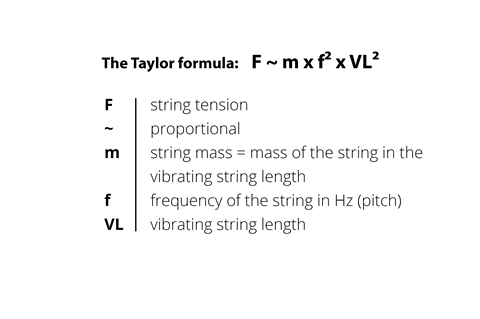
Encounter Taylor formula
To become the best from an instrument, nosotros recommend visiting an experienced double bass-maker instead. They will be able to adjust your instrument perfectly. As well as the string selection, the fingerboard curve, saddle peak and string superlative too play a crucial role.
Can a 3/four string exist strung on a four/iv bass?
No. The string tension of a three/4 string (104 cm) strung onto a 4/4 base (110 cm) is increased by +eleven.8%! It is necessary to pay particular attention to the bodily vibrating string length and so that neither the string nor the musical instrument are overloaded.
Can a 4/4 string exist strung on a iii/4 bass?
In principle, a music string is ever designed for a specific vibrating string length. This is why Thomastik-Infeld provides strings for 3/4 basses and for 4/4 basses which are perfectly suited for the size of the body and vibrating string length. Our strings are thus designed to support the musician, their style of playing and the instrument in equal measure. Ultimately, they aim to create the perfect sound on the musical instrument and optimize the musician's expressive possibilities and joy of playing. For this reason, nosotros recommend that you expect online at www.thomastik-infeld.com/catalog to find out near our product range or go advice from our new string finder at www.thomastik-infeld.com/stringfinder.
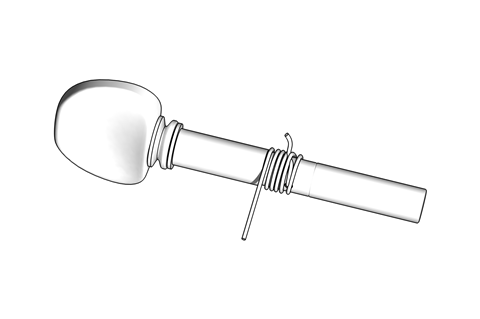
However, information technology is possible, in principle, to string a four/4 string on a three/four string if the cord is non likewise long. The of import thing is to annotation that using 4/four strings on a iii/4 double bass will pb to a reduction in string tension of upwards to -10.6%. Furthermore, the length of the string tin lead to the playing zone of the string (metal winding) being wound onto the peg – this should be avoided so that the string is not damaged!
- Read: Stringtelligence by Thomastik-Infeld: dealing with corrosion and perspiration
- Read: Stringtelligence by Thomastik-Infeld: What are violin, viola, cello and bass strings made out of
- Read: Stringtelligence past Thomastik-Infeld: combining different string types, Part 1
- Read: Stringtelligence by Thomastik-Infeld: combining unlike string types, Office ii
- Read: Stringtelligence by Thomastik-Infeld: wolf tones and cord buzzing

Can I Fit 4/4 Size Double Bass Strings On A 3/4 Size Double Bass,
Source: https://www.thestrad.com/accessories/stringtelligence-by-thomastik-infeld-double-bass-strings/9618.article
Posted by: cookstrent71.blogspot.com
0 Response to "Can I Fit 4/4 Size Double Bass Strings On A 3/4 Size Double Bass"
Post a Comment