

How To Size Cabinet To Fit Washer And Dryer
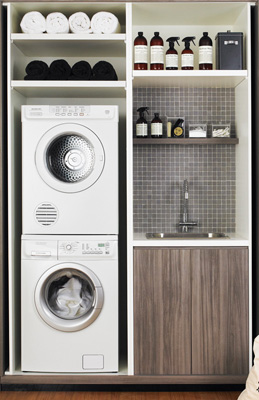
A European laundry (i.e. a laundry in a cupboard) lets you 'borrow' space from living areas when information technology's needed.
In that location's no such thing as a 'standard' size for laundries, any more than in that location is for any other room. Laundry rooms come up in all shapes and sizes, but regardless of how large they are (or even if they're integrated into a different space like a kitchen or bath), there's e'er a demand to ensure that in that location's enough space for:
- Washing machines, dryers, sinks, benches and laundry storage, and
- Moving around and working safely.
There are all kinds of ways to provision for both of these requirements - even in smaller spaces.
Typical space required for washers and dryers
Ideally, your building designer, architect or builder will decide what's best, and should know with a skillful amount of conviction how much room'southward required for your laundry appliances, storage and workspaces.
Washers and dryers are normally designed to fit into pocket-size spaces, but they'll still demand a minor amount of clearance to ensure that they're properly ventilated, and that they don't ruin your cabinetry when they vibrate. If y'all're non certain if yours has plenty infinite, bank check your possessor's manual to find out how much clearance the manufacturer recommends.
Below is a rough idea of the space required for unlike things in your laundry. If you plan on installing an unusually big machine, this is definitely something you'll demand to tell your builder or designer about.
Standard spaces for front loading washing machines / dryers:
- Width: 800mm (average machine is 600-700mm wide)
- Depth: 800mm (average machine is 600-700mm deep)
- Height: Average car is 800mm to 900mm tall.
Standard infinite for top loading washing machines:
- Width: 800mm (boilerplate motorcar is 500mm to 700mm wide)
- Depth: 800mm (average car is 500mm to 700mm deep)
- Top: Average machine is 800mm to 1100mm tall
Stacking a front loading washer and dryer (or mounting the dryer on the wall with a purpose-congenital bracket) tin help to halve the amount of floorspace they occupy.
Laundry design tip
- If you're going with a front-loading washer and/or dryer, talk to your designer nearly the possibility of mounting your washing machine at near twoscore-50cm above floor level - either in raised cabinetry with a drawer or void underneath for your laundry basket, or on a freestanding pedestal or bracket. This helps to salve a scrap of precious space, makes it far easier to load and empty your washer and dryer, and makes things easier to admission should you or anyone else always have a dorsum problem or a mobility issue.
Laundry trough dimensions and volumes
Once again, there'south a bit of freedom in terms of what you want from a laundry trough. If y'all're installing a workbench and cabinetry, you lot may want to utilise a driblet-in or nether-mount style sink for your laundry bowl.
If not, you can also opt for a 1 slice, free-standing 'laundry-trough-and-cabinet' blazon setup. Laundry troughs are typically made of stainless steel (which is quite durable).
Laundry troughs come in all kinds of shapes and sizes, and may feature:
- Side drain boards
- Double tub configurations
- Various unlike shapes
- Basket wastes
Typical laundry trough volumes:
- 30L
- 45L (the most mutual size)
- 70L
While these sizes are generally the more common options, laundry troughs do come up in all shapes, sizes and volumes.
The 'depth' of laundry troughs (i.e. the altitude from the front end of the trough back to the wall) tin can exist anywhere betwixt about 350mm and 600mm - for practical reasons (i.e. to ensure they fit well-nigh benches, and to ensure they're non hard to achieve over) they're rarely 'deeper' than this.
Standard laundry demote sizes
Bench height
As with kitchen benches, laundry benches are typically about 900mm loftier. This height suits virtually people, but if you're more comfy with a higher or lower bench this can exist set up at anywhere between 850mm and 1050mm.
Demote depth
The average nominal 'depth' of benches is about 600mm, although this can vary depending on infinite constraints, materials being used and other design considerations.
Ideal clearances
For reasons of convenience and safety, there are some basic recommendations in terms of the amount of infinite y'all should ideally have in front of your bench, trough and appliances. Designing with these distances in mind will also help to ensure that your house is usable for people with mobility issues.
The recommendations made in Livable Housing Australia'south design guidelines are intended to act as a guide to what's likely to be best for those with mobility issues or disabilities - and given that Australia's got a rapidly ageing population, it'due south e'er a practiced thought to take them into account. Livable Housing Australia provides ii different clearance recommendations, based on their aureate and platinum functioning levels:
- Gilded level: at least 1200mm clearance provided in front of fixed benches and appliances
- Platinum level: at least 1550mm clearance in front of fixed benches and appliances
European laundries (i.due east. compact laundries built into cupboards) are a great way to ensure in that location'southward plenty of clearance available without having to allocate dedicated floor space. These typically also utilise pocket doors which slide into the wall cavity, or a set up of bifold doors, to further reduce the amount of infinite that's needed.

How To Size Cabinet To Fit Washer And Dryer,
Source: https://build.com.au/standard-laundry-spaces-and-clearances
Posted by: cookstrent71.blogspot.com
0 Response to "How To Size Cabinet To Fit Washer And Dryer"
Post a Comment