

What Was The Size Of The First Floppy Disk
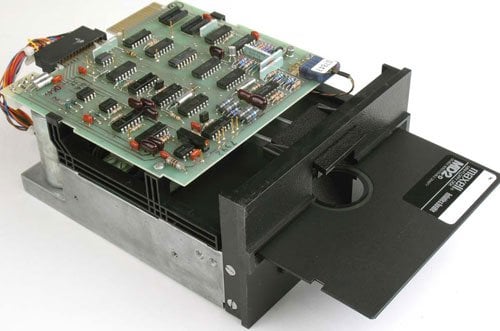
Most people know that the floppy deejay was invented in 1967 by a squad led by Alan Shugart at IBM. Notwithstanding, y'all can give its ideation and invention credit to Yoshiro Nakamatsu, a Japanese inventor.
Floppy disks accept been a crucial storage source at a time when there were no other options. The ideal storage version was 3.5 inches which stored nigh 1.44 MB. Today one camera flick might exceed this storage amount. Withal, in earlier times, this was the maximum storage option.
The guide provides you with data nearly the history of floppy disks. Read on to learn about the history and important facts about floppy disks.
5 Facts Near Floppy Disk
The floppy deejay was one of the greatest inventions for data storage during the 1960s. Below are some fun facts nigh this data storage device.
- Multiple floppy disks were required to install ane single program. Information technology was easy to store everyday files on i disk. However, when the size of programs started increasing, information technology became an unfeasible pick.
- The digital cameras used in the 90s had floppy disks equally their storage selection. The final model to utilise this storage option was the Sony FD Mavica FD200 in 2002.
- Floppy disks had an anti-wrote lock that prevented viruses from infecting the storage device. Users would have to eject the disk, unlock it, and insert it into the computer to enable the reader choice.
- Companies created cleaning kits to ensure the longevity of the floppy disks. This prevented the magnetic disk from dropping fragments in the drive and made the player unusable.
- Reckoner viruses are very common now and have unlike sources. However, floppy disks were the first source of estimator virus transmission. A malware called Elk Cloner was adult past 15-year old Rich Skrenta in 1982.
Floppy Disk History
Yoshiro Nakamatsu, also known as Dr. NakaMats, was the brain behind several notable inventions. He was born on 26th June 1928 and was labeled equally an eccentric inventor. He claimed to hold the world tape for several inventions. Those inventions include the floppy disk, armchair Cerebrax, the taxicab meter, the digital lookout, etc.
The United states Scientific discipline Academic Society voted Dr. NakaMats equally one of the five greatest scientists in history. This category also included Michael Faraday, Nikola Tesla, Marie Curie, and Archimedes.
The claims made by Yoshiro Nakamatsu might take been true since he licensed near a dozen of his patents in the 1970s. Each of these patents was related to floppy disk engineering.
Co-ordinate to Nakamatsu, the technology was invented by him during his pupil years at the University of Tokyo. However, several Japanese corporations turned down his request to produce the floppy disk. This led him to grant the sales license to IBM.

Floppy Deejay: How It Worked
To know how a floppy deejay works, you volition have to know the different parts of the disk drive. If you have e'er used a cassette record, you volition find a lot of similarities between the two.
The post-obit parts are present in a floppy disk –
Read/Write Heads: The heads are present on both sides of the disk but not directly opposite each other. One of the heads is used for reading and writing, while the other is used to erode data before writing a new one.
Drive Motor: A tiny spindle motor is present in the center of the deejay. This keeps the metal hub engaged and spins it at 300 or 360 rotations per minute.
Mechanical Frame: A protective window is present on the deejay, roofing the read/write heads. The mechanical frame is a set of levers that open this window to engage the heads with the dual-sided deejay media. On ejection, the window automatically closes and covers the heads.
Stepper Motor: The stepper motor makes precise stepped revolutions that motion the read/write head to the right rail position. This read/write head is attached to the shaft of the stepper motor.
Circuit Board: The circuit board controls all the electronics responsible for reading and writing the information.
Floppy Deejay: Historical Significance
The 1960s saw the need for a modest storage selection that was also removable. In this journey, IBM engineers developed an inexpensive and uncomplicated system for loading microcode into their System/370 mainframes in a procedure called Initial Control Plan Load (ICPL).
Ideally, this process would take been washed by using tapes. However, the tapes were bulky, large, and slow. IBM wanted a storage option that was much lighter and faster. They wanted to ship it out to the customers compiled with software updates.
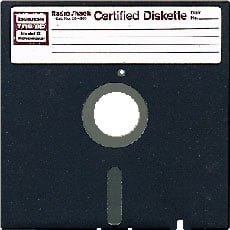
This led Alan Shugart, IBM Directly Access Storage Production Managing director, to assign David L. Noble to develop this selection. Noble experimented with RCA 45-rpm records, a magnetic disk with grooves, tape cartridges, dictating belts. Even so, he finally invented his floppy disk, which was called a memory deejay.
IBM introduced the read-merely disk in 1971, which held 80 kilobytes. This disk was named Minnow and was shipped as the 23FD, a standard part of System 37 processing units and other products.
IBM applied for a patent in 1970 and was granted the US patent Nr. 3678481 in 1973. The name was changed from Minnow to Igar in 1970, with sure improvements made by Noble and the squad.
Since the creation of the floppy deejay by IBM, there have been several improvements and changes. Alan Shugart developed Memorex 650, the first read/write FDD, in 1972. This was when Shugart left IMB and joined Memorex.
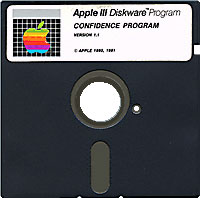
Shugart further established his own visitor, Shugart Assembly. The visitor produced the biggest floppy disk, an viii inches floppy disk that held 800k. Still, the size was said to be too big for personal computers. This led to the development of the five.25 inches FDD in December 1976.
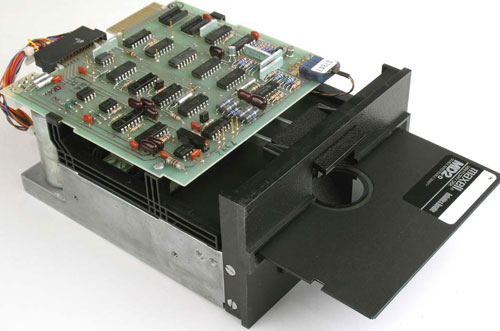
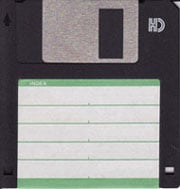
Since then, companies like IBM, Sony, Hitachi, Canon, etc., came up with their version of the floppy disks. Sony's iii.5 inches floppy drive became one of the most popular sizes and was used for several years. However, the emergence of CD drives drove floppy disks out of the market place and saw its end.
Floppy Deejay Explained: Everything You Demand to Know FAQs (Frequently Asked Questions)
When was the floppy disk invented?
The ideation credit can exist given to Yoshiro Nakamatsu. However, the bodily floppy deejay was created in 1967 by IBM. Furthermore, they developed some other in 1971 with several improvements. This floppy disk was an 8 inches square instance with a magnetic disk. This was a read-only floppy disk drive.
What is a floppy disk?
A floppy deejay or floppy diskette is a storage device created to concord electronic data. IBM created the commencement floppy disk in 1967. This was made as an alternative to difficult drives since they were extremely pricey at the time.
The deejay needs to exist inserted into a floppy bulldoze to read and write. These disks were used to store a maximum of 1.44 MB of data and were iii.5 inches in size. However, different companies came upwards with multiple sizes for the floppy deejay.
Are floppy disks still made?
No, there are no notable manufacturers of floppy disks in current times. Sony, which was a dominant thespian in this market, stopped its manufacturing in March 2011. However, there are nevertheless some regime agencies and industrial sectors that might utilize floppy disks.
Even then, the market is so low that most big companies practice not participate in the manufacturing process. Moreover, contempo hard drives have more advantages equally compared to floppy disks.
Why are floppy disks no longer used?
Technological advancements have offered people far amend and larger capacity storage drives. Hence, floppy disks have get severely insignificant. Instead, people can utilise difficult deejay drives that provide a storage chapters of 1TB, 2TB, 5TB, etc.
Apart from this, floppy disks were extremely sensitive to grit and moisture. The maintenance was high, without which the disks would become corrupted or unusable. Moreover, the data transfer rate of floppy disks is very low, which is one of the biggest disadvantages. Most computers do non have floppy drives in current times.
What does a floppy disk do?
A Floppy disk is a magnetic storage option used to transfer files, back-up information, and distribute software.
What were the different sizes of floppy disks?
At that place are three major types of sizes of floppy disks – eight inches, 5.25 inches, and iii.5 inches. The 8 inches floppy disk was introduced in 1971, whereas the 5.25 inches was adult in 1976. Nonetheless, the 3.5 inches was the most popular size out of the three.
IBM developed the 3.5 inches in 1984. These floppy disks had a total capacity of 720 KB and were widely in demand. Sony manufactured the iii.5 inches floppy disks, which saw huge sales during the 1990s and 2000s.
Who invented the floppy disk?
Yoshiro Nakamatsu claims to take invented the floppy disk. When he failed to become the disk produced past leading Japanese corporations, he sold the sales license to IBM. After this, IBM came upwardly with their floppy disk versions, starting with the eight inches version.
The 8 inches floppy disk was called Minnow and held 80 kilobytes of data. Several improvements to the floppy disk accept been made, with the three.v inches equally the almost used size.

What Was The Size Of The First Floppy Disk,
Source: https://history-computer.com/floppy-disk/
Posted by: cookstrent71.blogspot.com
0 Response to "What Was The Size Of The First Floppy Disk"
Post a Comment